
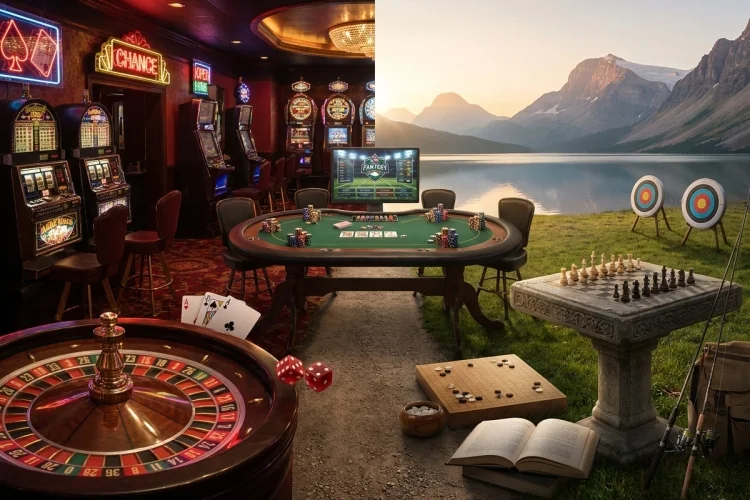
Games of Chance vs. Games of Skill: A Beginner’s Guide
Why can an experienced chess player consistently defeat a beginner, while an expert cannot reliably predict the next roulette number? The answer lies in the balance between skill and chance.
Understanding games of chance vs. games of skill helps players evaluate how much control they actually have over an outcome. In a game of chance, luck or a random process largely determines the result.
In a skill-based game, knowledge, practice, physical ability, or decision-making has a meaningful influence on performance.
The distinction is not always simple. Poker, blackjack, fantasy sports, and some modern electronic games combine random events with strategic choices. A player may make excellent decisions and still lose a particular round because of an unlucky card, roll, or draw.
Legal definitions also vary between jurisdictions. A game considered skill-based in one region may be regulated as gambling elsewhere. For that reason, the difference should be understood as a spectrum rather than a perfectly clear dividing line.
What Is a Game of Chance?
A game of chance is one in which an unpredictable event substantially affects the result. The outcome may be produced by shuffled cards, dice, a spinning wheel, randomly selected numbers, or computer-generated values.
Common examples include lotteries, slot machines, roulette, bingo, and many dice games. Once a lottery ticket has been purchased or a roulette wager has been placed, the participant has little or no ability to influence the winning result.
The UK Gambling Commission defines gaming as playing a game of chance for a prize. Under its framework, a game can remain a game of chance even when it also contains an element of skill.
What Is a Game of Skill?
In a game of skill, a participant’s decisions or abilities significantly influence the outcome. Relevant skills may include memory, calculation, reaction speed, strategic planning, accuracy, or knowledge.
Chess is a clear example. Players control every move, study previous positions, and improve through practice. Although the initial choice of who moves first introduces a small random element, the UK Gambling Commission considers that chance too minor to define the nature of the game.
Other examples may include competitive puzzles, darts, certain sports, and knowledge-based contests. A stronger participant should generally achieve better results more consistently than a beginner.
Why Many Games Are a Mixture
Most games do not fit perfectly into one category. They contain different proportions of chance and skill.
Poker involves randomly dealt cards, but players also decide whether to bet, raise, call, bluff, or fold. Research using online poker records has found evidence that successful performance can persist over time, suggesting that ability affects long-run results.
Nevertheless, chance remains highly influential over individual hands and shorter sessions.
Blackjack is another mixed example. A player can choose whether to hit, stand, split, or double. Better decisions may improve the expected result, but the player cannot control which card is dealt next.
Short-Term Luck and Long-Term Skill
The time period used to measure results matters. Chance can dominate a single round even in a skill-heavy game.
A beginner might defeat an experienced poker player during one hand after receiving unusually strong cards. Over thousands of hands, however, differences in decision quality may become easier to observe.
The opposite is also true. Practice cannot make a lottery number predictable because the participant has no meaningful decision to improve. In purely random games, a longer period does not transform luck into skill.
Academic studies use different methods and thresholds to measure the relative contribution of ability and randomness. As a result, researchers can reach different conclusions about mixed games such as poker.
Skill Does Not Guarantee Profit
Calling a game skill-based does not mean every skilled participant will earn money. Entry fees, casino advantages, commissions, stronger opponents, and natural variation can all affect results.
In poker, for example, participants may compete against one another while the operator collects a fee. A player therefore needs to outperform both the opponents and the cost of participation.
Casino games involving decisions may also have a theoretical return calculated using a standard playing strategy. Using that strategy may reduce avoidable mistakes, but it cannot eliminate random losses or guarantee a positive result.
Why the Difference Matters Legally
The classification of a game can determine whether it requires a gambling licence, where it may be offered, and which consumer protections apply.
Different legal systems use different tests. Some ask whether chance is the dominant factor, while others consider whether chance has any meaningful effect. New Jersey regulations, for example, describe approved skill-based casino games as games in which return depends on physical dexterity or mental ability rather than a precise chance-based model.
Players should therefore avoid assuming that a “skill game” label automatically makes a paid contest legal. Local rules, prize structures, entry fees, and game design all matter.
How to Evaluate Any Game
Ask whether practice allows strong players to perform consistently better. Then identify which parts of the result remain outside the participant’s control.
Consider whether decisions change the probability of success or simply change the amount being risked. In roulette, selecting different numbers changes bet coverage, but it does not allow the player to control the wheel.
Finally, separate entertainment from financial expectation. Gambling involves risking something valuable on an uncertain outcome and can cause significant financial and personal harm.
The central difference between games of chance and games of skill is the amount of meaningful control available to the participant. Roulette, lotteries, and slots are primarily driven by random outcomes.
Chess and many competitive sports depend much more heavily on knowledge, practice, and execution. Poker, blackjack, and similar products fall somewhere between those two ends.
The label alone does not reveal whether a game is profitable, safe, or legally permitted. Mixed games can still produce severe short-term losses, while skill-based contests may involve fees and highly capable opponents.
Before paying to participate, study the rules, identify the random elements, and check the laws in your jurisdiction. Treat any wager as money that may be lost, and never chase an unfavorable result.