
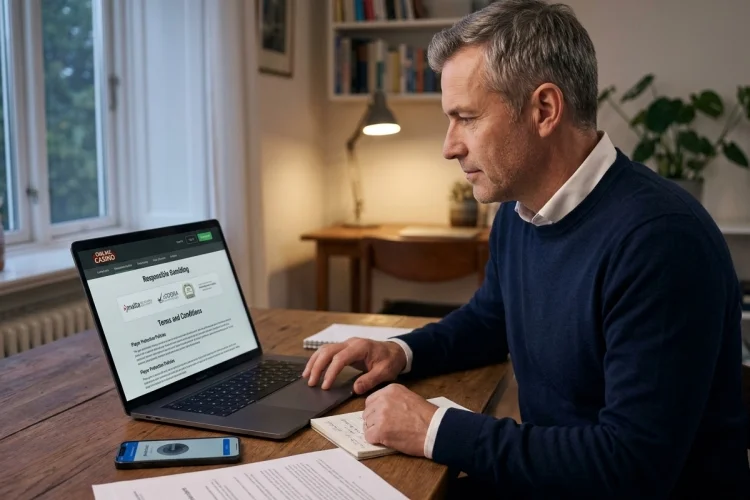
Online Casino Trustworthy or Not? A Practical Safety Checklist
Finding an online casino takes seconds. Figuring out whether you should trust it requires a little more work.
A professional-looking homepage can be copied, a security logo can be pasted into a footer, and an enormous bonus can be advertised with impressive graphics. None of those things independently prove reliability.
Deciding whether an Online Casino Trustworthy claim deserves confidence means verifying information outside the casino itself.
Licensing records, withdrawal rules, customer-fund arrangements, game testing, identity procedures, and dispute options provide much stronger clues. Here is a practical way to investigate them before putting money at risk.
Start by Checking the Licence Against the Exact Website
The first step should happen outside the casino’s own website.
Find the operator’s legal name, licence number, and claimed regulator. Then visit the regulator directly.
The UK Gambling Commission’s public register, for example, lets consumers search gambling businesses by business name, trading name, domain name, or account number and check the licence status.
That domain check is particularly useful.
A fraudulent website could theoretically copy the name and licence number of a legitemate operator. Finding a valid company in a regulator’s database is therefore not enough if the domain you are using does not correspond with the licensed operation.
You can also look for past regulatory action. The UKGC public register includes sanctions and settlements for a specified publication period.
A regulator’s register gives you evidence. A logo in a footer gives you only a claim.
Do Not Treat Security Logos as Proof
Seeing SSL, encryption, payment, or testing logos may look reassuring, but images are easy to copy.
A better approach is to look at the complete security picture.
Does the website use an encrypted HTTPS connection? Does the operator explain how personal information is processed? Are account-security tools available? Is document upload handled inside an authenticated environment rather than through a suspicious third-party channel?
In Britain, remote gambling security standards cover sensitive customer information, authentication data, customer balances, game results, RNG systems, network security, cryptography, logging, malware protection, backups, and access controls.
Applicable licensees are also subject to third-party annual security-audit requirements.
That does not mean you can personally inspect the operator’s servers.
It means a regulator-backed security framework provides more meaningful evidence than a decorative “secure casino” badge.
Look at the Games and Their Testing
A trustworthy online casino should explain where its games come from.
Recognised game suppliers are easier to investigate than anonymous titles with no identifiable developer. For RNG-based games, independent testing is especially relevant.
GLI provides testing services covering game mathematics, percentage return to player, RNGs, gaming platforms, live dealer systems, and security auditing.
Its RNG testing examines randomness and whether unacceptable bias or predictability exists.
Be cautious with vague claims such as “certified fair” if there is no explanation of who performed the certification.
Even when a testing-laboratory logo appears, check whether it links somewhere meaningful or whether the testing organisation offers a way to verify the relationship.
A fake seal is easy to create.
A genuine testing and regulatory trail is much harder to imitate consistantly.
Read Withdrawal Terms Before Testing a Deposit
Many people check deposit methods first and withdrawal rules later.
Reverse that order.
Before depositing, investigate withdrawal methods, processing information, verification procedures, potential fees, account restrictions, and bonus terms.
Watch for vague clauses giving the operator extremely broad discretion over winnings without explaining the circumstances.
Under UK rules, gambling terms must be fair and transparent, material changes must be communicated, and important contractual information must be easily accessible.
British rules also prohibit promotional wagering requirements from being applied to a player’s deposit balance, and cash and bonus balances must be shown separately.
Other countries may use different standards.
Wherever the casino is regulated, however, the withdrawl process should not feel like a mystery that only becomes visible after winning.
Find Out What Happens to Money Held in Your Account
An account balance is effectively money being held by the operator until it is withdrawn or wagered.
That makes customer-fund arrangements worth checking.
In Great Britain, online operators holding customer funds must keep them in a separate account and disclose their level of insolvency protection to customers.
The UK framework uses specific protection categories, so even a licensed operator does not automatically mean every balance receives identical protection if the company fails.
Other regulatory jurisdictions have their own approaches.
The broader lesson is to look beyond game fairness. Ask what happens to your money if the business itself gets into trouble.
For larger balances especially, the answer can matter more than an extra percentage point in a welcome bonus.
Identity Checks Can Be Normal – Timing Matters
A request for identification sometimes worries new players, but regulated gambling operators can have legitimate legal reasons for verifying identity.
UK-licensed online operators must verify a customer’s identity before permitting them to gamble, including information such as name, address, and date of birth.
The UK Gambling Commission also states that an operator should not wait until withdrawal to request information it could reasonably have asked for earlier, although additional checks can sometimes be required later to meet other legal obligations.
That creates a useful practical distinction.
An organised verification process clearly explained before play can be normal. A mysterious demand for unusual documents appearing only after a large win deserves closer examination.
Never send sensitive documents through an unfamiliar email address or messaging account simply because someone claims to represent the casino.
Use the official verfication channel stated by the licensed operator.
Check Whether There Is a Real Route for Complaints
Customer support and a complaint process are not the same thing.
Live chat can answer ordinary questions, but serious disputes about withdrawals, bonus terms, account closure, or game results need a more formal route.
UK Gambling Commission guidance requires licensed businesses to maintain fair, accessible complaint procedures and provide qualifying customers with access to independent Alternative Dispute Resolution if the dispute remains unresolved.
For consumers, UKGC guidance says the first step is generally to complain directly to the gambling business and follow its formal procedure. If an eligible dispute cannot be resolved, ADR may provide an independent escalation route.
A useful trust check is therefore simple:
Can you easily find the complaints policy, company contact details, escalation procedure, and external dispute provider?
If not, ask yourself how difficult communication might become when real money is involved.
Look for Tools That Let You Control Your Gambling
A responsible operator should make it possible to set boundaries rather than encouraging unlimited play.
In regulated markets, these can include deposit or financial limits, transaction histories, time-management tools, reality checks, cooling-off features, and self-exclusion options.
The UK Gambling Commission’s remote standards require financial-limit facilities and rules governing how customer-led limits operate.
Such tools do not prove an operator is perfect.
However, a site that makes spending controls visible and accessible offers a very different user experience from one that hides them while constantly pushing deposits.
Another warning sign is aggressive communication after you have asked to stop marketing or limit activity.
Trust includes how a company behaves when you want to gamble less – not just when it wants another deposit.
Know the Biggest Red Flags
No single warning sign proves that a website is fraudulent, but combinations should make you cautious.
Examples include a licence that cannot be found in the regulator’s database, a domain that does not match the licensed operator, anonymous company ownership, copied regulatory seals, unclear withdrawal rules, inaccessible terms, or support staff who refuse to explain the complaints process.
Guaranteed-win language is another concern. Casino games involve risk, so claims implying that profit is certain should immediately invite scrutiny.
Be equally cautious when someone pressures you to deposit through unusual payment channels or asks you to transfer money directly to an individual.
The goal is not to decide based on one attractive or unattractive feature.
Trust comes from evidence that remains consistant when you check the licence, terms, security, payments, games, and consumer protections from several directions.
Deciding whether an Online Casino Trustworthy claim is credible requires verification, not guesswork.
Start with the regulator’s public register, then examine security, game testing, withdrawal policies, customer-fund protection, identity procedures, responsible gambling tools, and complaint options.
Do those checks before depositing, not after a problem appears. A trustworthy-looking website is easy to build; a verifiable regulatory and operational history is much harder to fake.