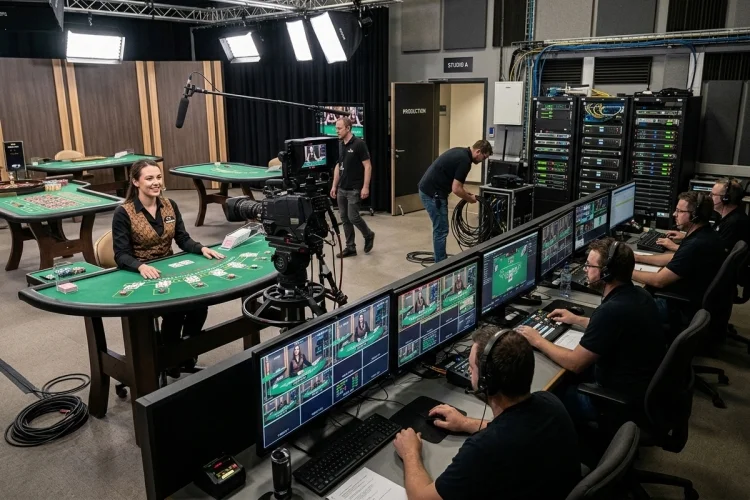

Live Casino Latency: Inside the Race to Keep Every Bet in Sync
A player taps a blackjack decision button and expects an immediate response. Meanwhile, the dealer is operating a physical table in another location, a video stream is travelling across the internet, and the backend is processing the current round. Making all of that feel instantaneous is harder than it looks.
Live Casino Latency is the hidden delay connecting those actions. It comes from video capture, encoding, network travel, buffering, decoding and transaction processing. Low-latency technologies such as WebRTC can reduce host-to-viewer delay dramatically; Amazon IVS, for example, documents real-time streaming that can operate below 300 milliseconds.
Yet the lowest number is not always the best player experience. Stability and synchronisation matter just as much as raw speed.
Live Casino Has More Than One Latency Clock
The easiest mistake is to think of latency as one universal delay.
A live casino actually contains several timing paths.
The dealer and physical table operate in real time.
The camera produces a video timeline.
The game server controls betting states.
Player actions travel back to the backend.
Outcome data then triggers settlement.
AWS’s reference architecture for betting and casino workloads separates live video transmission from game metadata and interactive API traffic, showing how these components can use different technical paths.
This means a player could have smooth video while transaction responses feel slow.
The opposite can also happen: the interface reacts quickly while the video sits slightly behind.
The objective is to make all these clocks appear unified.
Video Latency Starts Before the Internet
Not every millisecond comes from network distance.
Delay begins inside the studio.
A camera captures frames. Those frames may be processed, combined with audio and encoded before transmission.
After reaching streaming infrastructure, the content may be packaged, distributed, buffered and decoded again on the player’s device.
Traditional streaming can create substantial delay. Amazon notes that conventional over-the-top video may reach roughly 30 seconds of latency, while its specialised low-latency service targets less than five seconds and real-time streaming can fall below 300 milliseconds.
Live casino needs the lower end of that spectrum because players are not merely watching.
They are interacting with an active game.
A 20-second delay might be acceptable during certain broadcasts. At an interactive roulette table, it would make the relationship between betting and visible action extremely awkward.
Transaction Latency Has a Different Job
When a player presses Hit, Stand or places a roulette bet, that action does not have to wait for the video stream to travel back to the studio.
The request can move through a separate data connection.
Modern architectures commonly use APIs or persistent WebSocket connections for interactive events. AWS’s betting-and-gaming architecture uses these channels for game metadata and player actions alongside the streaming system.
The backend then determines whether an action arrived while the current state allowed it.
That distinction protects the game from differences in local video delay.
Suppose two players have video streams separated by 500 milliseconds.
The authoritative server can still enforce one betting deadline for both.
This makes transaction latency more important to fairness than simply matching what each player’s video seems to show.
Milliseconds Matter Most Near a Betting Deadline
Latency is barely noticeable when a dealer is greeting the table.
It becomes much more important during a closing betting window.
Imagine a roulette countdown showing one second remaining.
The player submits a wager.
The request travels through the network and reaches the server after betting has closed.
From the player’s perspective, the click looked timely.
From the authoritative game state, it was late.
This is why good interfaces need to account for communication delay instead of presenting a misleading sense of unlimited last-second precision.
Round-trip time, or RTT, describes the time required for data to travel to a destination and for an acknowledgement to return.
Lower RTT generally gives an interactive application more room to respond before a deadline.
But even good average RTT cannot guarantee that every packet will arrive equally quickly.
Jitter Creates the Unpredictability Players Notice
A steady 500-millisecond delay can sometimes feel surprisingly smooth.
A stream jumping between 200 milliseconds and two seconds feels far worse.
The difference is jitter.
Network jitter occurs when packets arrive at inconsistent intervals, commonly because of factors such as congestion, packet loss or changing network paths. High jitter can degrade real-time video and gaming applications.
Streaming clients compensate with jitter buffers.
The buffer holds incoming media briefly so irregular packet arrival does not immediately produce visible stuttering.
But buffering creates an unavoidable compromise.
Increasing the buffer can improve resilience to retransmissions and packet loss, while potentially adding more delay to playback.
This is why latency engineering often looks less like a race to zero and more like a balancing problem.
Timed Metadata Keeps Interactive Elements Aligned
Live casino interfaces usually display information on top of or beside the video.
A roulette screen may show the winning number.
Blackjack can display card totals.
Baccarat may update roadmap information.
If these elements appear too early, they can reveal the digital result before the physical broadcast catches up.
If they appear too late, the interface feels sluggish.
Timestamped metadata offers one technical approach to coordinating these elements.
Amazon IVS supports timed metadata embedded into a stream and synchronised with its audio and video frames, allowing viewer-side actions to trigger at the appropriate relative point in playback.
This type of mechanism demonstrates an important principle for live casino design:
Synchronised information is often more valuable than information delivered as early as technically possible.
That principle makes the whole enviroment feel coherent.
Synchronicity Is Important Enough to Be Tested
Live dealer systems are not evaluated solely by checking whether the video loads.
Gaming Laboratories International says its live dealer evaluations include technical, systems and synchronicity tests, alongside inspection of the studio and player-facing systems.
That reflects the fundamental complexity of the product.
The physical roulette wheel may work perfectly.
The camera may work perfectly.
The backend may correctly calculate settlements.
Yet if those systems become badly desynchronised, the complete experience can still fail.
Testing therefore needs to examine relationships between components.
Does a card displayed in the interface match the card currently visible?
Does the betting window close at the right stage?
Does the result belong to the correct round?
Latency becomes an integrity issue when timing errors cause those relationships to break.
Poor Connections Require Graceful Degradation
Low-latency systems also have to expect imperfect networks.
Broadcast connections can experience congestion, temporary connectivity loss or interruptions in content generation. AWS lists these among common causes of low-latency streaming problems.
A resilient player application may need to adapt.
It can increase buffering, reduce video quality or reconnect to the stream while keeping authoritative game-state information separate.
The important point is that a poor video connection should not create uncertainty about which bets were accepted.
The transaction record remains more important than whether a player briefly missed several frames.
From a user-experience perspective, graceful degradation is often better than aggressively chasing low latency until the stream becomes unstable.
A slightly slower but continuous table usually feels more polished than a theoretically faster feed that freezes every few rounds.
Scaling Latency Across Thousands of Live Tables
Latency engineering becomes considerably harder at scale.
Evolution says its current live offering operates across more than 2,000 tables and game-show environments in multiple languages and regulated markets. Its engineering organisation explicitly identifies low game latency as part of delivering a flawless player experience.
Large-scale infrastructure has to account for players connecting from many networks and regions simultaneously.
One route may be excellent while another is congested.
One player’s device may decode high-quality video easily while an older smartphone struggles.
The platform therefore needs monitoring and adaptive delivery rather than one fixed configuration for every connection.
Low latency is not a single feature switched on at the studio.
It is an end-to-end property of the entire technical chain.
The Fastest System Still Needs an Authoritative Record
A final distinction matters.
What a player sees is a presentation of the live round.
The authoritative game record is what determines accepted wagers and outcomes.
The UK Gambling Commission requires live dealer operations within its jurisdiction to remain fair and independently auditable.
That requirement matters when latency or connectivity creates disagreement between screen presentation and backend events.
If a video freezes just before the ball lands, the actual roulette result still exists.
If a user interface temporarily stops updating, accepted wagers still need to be recorded correctly.
Speed improves experience.
Reliable records protect integrity.
A strong architecture needs both.
Live Casino Latency is a combination of video delay, transaction timing, jitter, buffering and synchronisation rather than one simple speed figure. Milliseconds matter most when players are interacting with betting windows and game decisions.
Look beyond headline streaming speed: a great live casino experience depends on keeping video, data and accepted actions aligned even when networks are less than perfect.