
Probability in Casino Games: Simple Examples With Cards and Dice
Probability can sound complicated when it is presented through formulas alone. Casino games make the subject easier to visualize because every wager connects possible outcomes with a prize or loss.
In dice games, probability depends on the number of ways a total can be formed. In roulette, it comes from the number of pockets on the wheel.
Card-game probabilities change as cards are dealt, while slot outcomes are generated through tested game systems and measured through theoretical return percentages.
This simple guide to probability in casino games uses practical examples rather than advanced mathematics.
It explains why rolling a seven is more likely than rolling a two, why a roulette color is not an even 50-50 wager, and why previous random results do not make a future result more predictable.
These examples can improve awareness, but they cannot remove the casino’s built-in advantage. Even a correctly calculated probability does not guarantee that the expected result will appear during one short session.
Starting With Equally Likely Outcomes
When every possible outcome has the same chance, probability is calculated by dividing favorable outcomes by all available outcomes.
For one fair six-sided die, the probability of rolling a six is:
1 ÷ 6 = 16.67%
The probability of rolling a number greater than four is:
2 ÷ 6 = 33.33%
The favorable outcomes are five and six. This simple counting method becomes more detailed when a game uses multiple dice, cards, or wheel pockets.
Why Dice Totals Have Different Probabilities
Two six-sided dice create 36 equally likely ordered combinations. A total of seven can be made in six ways:
1+6, 2+5, 3+4, 4+3, 5+2, and 6+1
Its probability is therefore:
6 ÷ 36 = 16.67%
A total of two can occur only as 1+1, giving it a probability of:
1 ÷ 36 = 2.78%
This is why casino dice paytables do not treat every total equally. Outcomes that sound equally simple can have very different mathematical likelihoods.
Calculating Roulette Probabilities
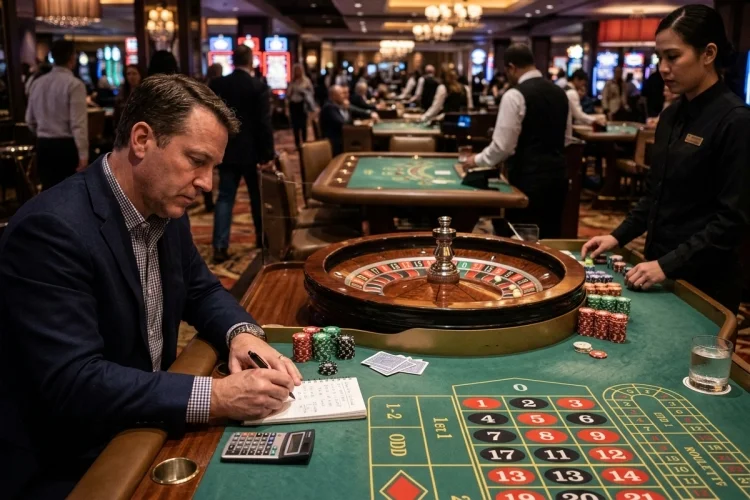
A traditional double-zero wheel contains 38 equally likely pockets: 18 red, 18 black, zero, and double zero.
The probability of winning with one selected number is approximately 2.63%. The chance of winning a standard red or black wager is approximately 47.37%.
Although red and black each cover 18 numbers, the two green pockets create additional losing outcomes. This prevents the wager from being a true coin flip.
A triple-zero wheel contains 39 pockets, adding 000 to the usual numbers and zero pockets. This lowers the probability of winning ordinary single-number and even-money bets compared with a 38-pocket wheel.
Understanding Card Probabilities
A standard deck contains 52 cards divided among four suits and 13 ranks. The probability of drawing an ace from a full shuffled deck is:
4 ÷ 52 = 7.69%
If the ace is not returned before another card is drawn, only 51 cards remain. The probability of drawing a second ace becomes:
3 ÷ 51 = 5.88%
These events are dependent because the first result changes the composition of the deck. When a card is replaced and the deck is restored, later probabilities return to their original values.
Why Blackjack Requires Conditional Probability
Blackjack probabilities are more complicated than a single card draw. The best decision can depend on the player’s cards, the dealer’s visible card, the number of decks, and the rules governing hits, doubles, splits, and dealer actions.
Because cards are dealt without immediate replacement, the probability of future cards changes as the hand develops. This is an example of conditional probability: the likelihood of an event is evaluated using information about what has already occurred.
Blackjack also involves player decisions. Academic analysis from UNLV notes that the house advantage depends on both game rules and the player’s ability.
This means one universal blackjack probability cannot accurately describe every table or playing decision.
Slot Probability and Random Outcomes
Modern slot games may contain many possible symbol combinations, paylines, bonus events, and prize levels. Players normally see an RTP figure instead of a complete list of probabilities for every outcome.
Theoretical RTP is calculated across a large volume of play. The UK Gambling Commission explains that a displayed return percentage should not be interpreted as the amount an individual player will receive during a session.
For random machines, previous wins and losses do not change the odds of the current game. A long period without a bonus feature does not prove that the feature must appear soon.
Volatility also matters. Games with similar RTP figures can distribute returns differently, producing either relatively frequent smaller prizes or less frequent larger wins.
Probability Does Not Equal Profitability
A wager may have a relatively high probability of winning while still being unfavorable. The payout must be considered alongside the winning chance.
Suppose a fictional wager wins 60% of the time but returns only $0.50 in net profit when it wins, while losing $1 when it fails. Across 100 theoretical $1 bets, the expected wins produce $30, while the expected losses cost $40.
The expected result is a $10 loss despite the wager winning more often than it loses. Expected value is therefore more useful than win frequency alone because it combines probability with each possible financial outcome.
Casino probability becomes easier to understand when each game is broken into outcomes. Dice totals depend on the number of combinations, roulette probabilities come from wheel pockets, and card-game odds change when cards are removed from the deck.
Slots use much larger mathematical models, so their long-term behavior is commonly expressed through RTP. In every case, probability must be considered together with the paytable and expected value.
Before wagering, examine the exact rules rather than relying on the game’s name. Compare probabilities, payouts, RTP, and playing speed, then establish firm spending and session limits. Use these calculations to understand how the game works – not to predict a guaranteed result.